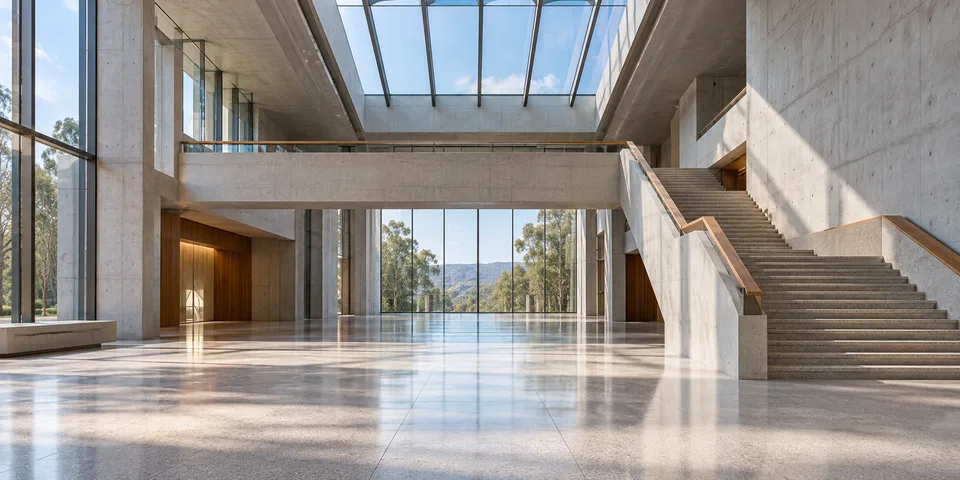
The High Court of Australia is a public institution as well as one of Canberra’s most distinctive buildings. In the Parliamentary Triangle on Parkes Place, between the National Gallery of Australia and the National Portrait Gallery, it offers a different kind of cultural visit: the chance to understand a working national court through its public spaces, Court Guides and, when sittings are underway, the courtrooms themselves.
The building’s concrete-and-glass form is part of the experience. The Court describes a large public hall, three courtrooms, an administrative wing and Justices’ chambers, with public access to the courtrooms from the hall. Treat it as a place where architecture, civic life and formal procedure meet, rather than as a conventional museum.
General visitors and small groups can self-guide through the building during ordinary public opening hours. Court Guides are available in open courtrooms to explain the Court’s role, history, architecture and operation. That makes the visit accessible even if you have not studied law: start in the public areas, ask a Guide for orientation and allow the building’s spatial sequence to set the pace.
The Court also offers a free booked public tour for social groups of more than 10 participants. If a group visit is important to your plans, use the Court’s published booking contact rather than arriving with an unconfirmed expectation. The official site says the Canberra building is normally open to the public on weekdays from 9:45am to 4:30pm; check the current details before travel.
Court sittings can give a visit an immediate sense of the institution at work, but they are subject to the Court calendar and seating availability. The Court says oral arguments are open to the public where seats are available, and asks visitors to remain in a courtroom for at least 10 minutes. Check the Court calendar before planning around a hearing and follow the directions of Court Guides and security staff on the day.
All visitors pass through security screening. The High Court also publishes requirements about items that must be cloaked and electronic devices in sitting courtrooms. Packing lightly and reading the visitor conditions in advance makes for a calmer entry and helps preserve the atmosphere required in a working legal setting.
Public entry is through the Level 2 forecourt entrance at the top of the ceremonial ramp from King Edward Terrace. The accessible entrance is at ground level via Parkes Place East, with accessible drop-off and pick-up spaces nearby. The Court says all public areas are accessible, with lifts serving the five public levels, and trained assistance animals are welcome with their handlers.
Nearby paid parking is available around Parkes Place, while the building’s position makes it easy to combine with neighbouring institutions on foot. Give yourself time for screening and entry, especially if you are aiming for a particular sitting or tour.
The High Court’s heritage and architecture are central to why a visit is worthwhile. The Court identifies the building as a significant Canberra work, and the public hall provides the route into its courtrooms and public galleries. A visit works best when you leave room to look at the spaces, speak with a Guide and, if conditions allow, observe a short part of a sitting with the required respect.
Sources last validated: 15 September 2026.