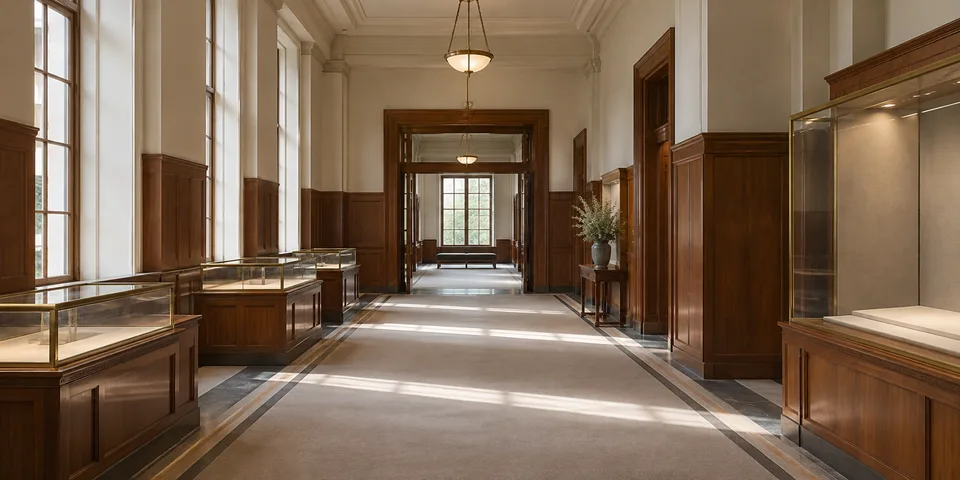
The Museum of Australian Democracy sits inside Old Parliament House, the building that housed Australia�s federal government from 1927 to 1988. A visit combines historic rooms with exhibitions that explore how Australian democracy has developed, been debated and continues to change. It is a particularly good choice if you want to understand Canberra through the everyday spaces where national politics once happened.
Old Parliament House was designed as a provisional home for the national parliament, but grew with the needs of government over decades. The Museum�s own account places the building at the centre of significant decisions, meetings and protests in Australia�s history. That background makes the corridors, chambers and office suites as important as a conventional exhibition object.
Allow time to move through the preserved rooms rather than treating the building as a quick photo stop. The Museum says original spaces include the chambers, Cabinet room and other rooms used for political work, alongside contemporary exhibitions about democracy. This mix lets you connect the physical setting with questions about public debate, representation and participation.
The permanent and changing display programme can add different angles to a return visit, so check the Museum�s current information before travel. A self-guided approach works well: start with the chambers and nearby historic rooms, then choose one exhibition topic to explore in more depth instead of trying to absorb every story in one pass.
The Museum provides step-free access to every level, with lifts connecting its main floors. Courtesy wheelchairs and strollers are available, and mobility scooters may be used throughout the Museum. As a heritage building, some rooms are smaller or have narrow spaces, and the Museum identifies particular areas of the chambers and upper galleries that are not accessible to wheelchair users. Its detailed access guide is the right reference when planning an itinerary around specific spaces.
The Museum Experience team can help with pre-visit questions and is available at reception and King�s Hall. If sensory, lighting, mobility or content considerations matter to your visit, use the Museum�s official access guidance before arrival rather than leaving all decisions to the day.
The Museum is at 18 King George Terrace in Parkes. Its current visitor guidance warns of building works that can affect the visual environment and introduce some construction noise. Parking is available around Old Parliament House, with free accessible parking and accessible pick-up and drop-off at the front. Public transport stops are within walking distance, and the Museum is readily combined on foot with other Parliamentary Triangle institutions.
Because the building is a heritage site with a large footprint, arrive with enough time to orient yourself at reception and decide which rooms matter most to you. That makes the visit less about rushing through political history and more about seeing how the spaces themselves supported democratic life.
The Museum of Australian Democracy works best as an unhurried visit. Move from the public rooms into the chambers, trace the building�s changing purpose, and use the exhibitions to ask how civic institutions affect everyday life. The setting gives historical stories a tangible scale, while the Museum�s democracy focus keeps the visit connected to the present.
Sources last validated: 15 September 2026.